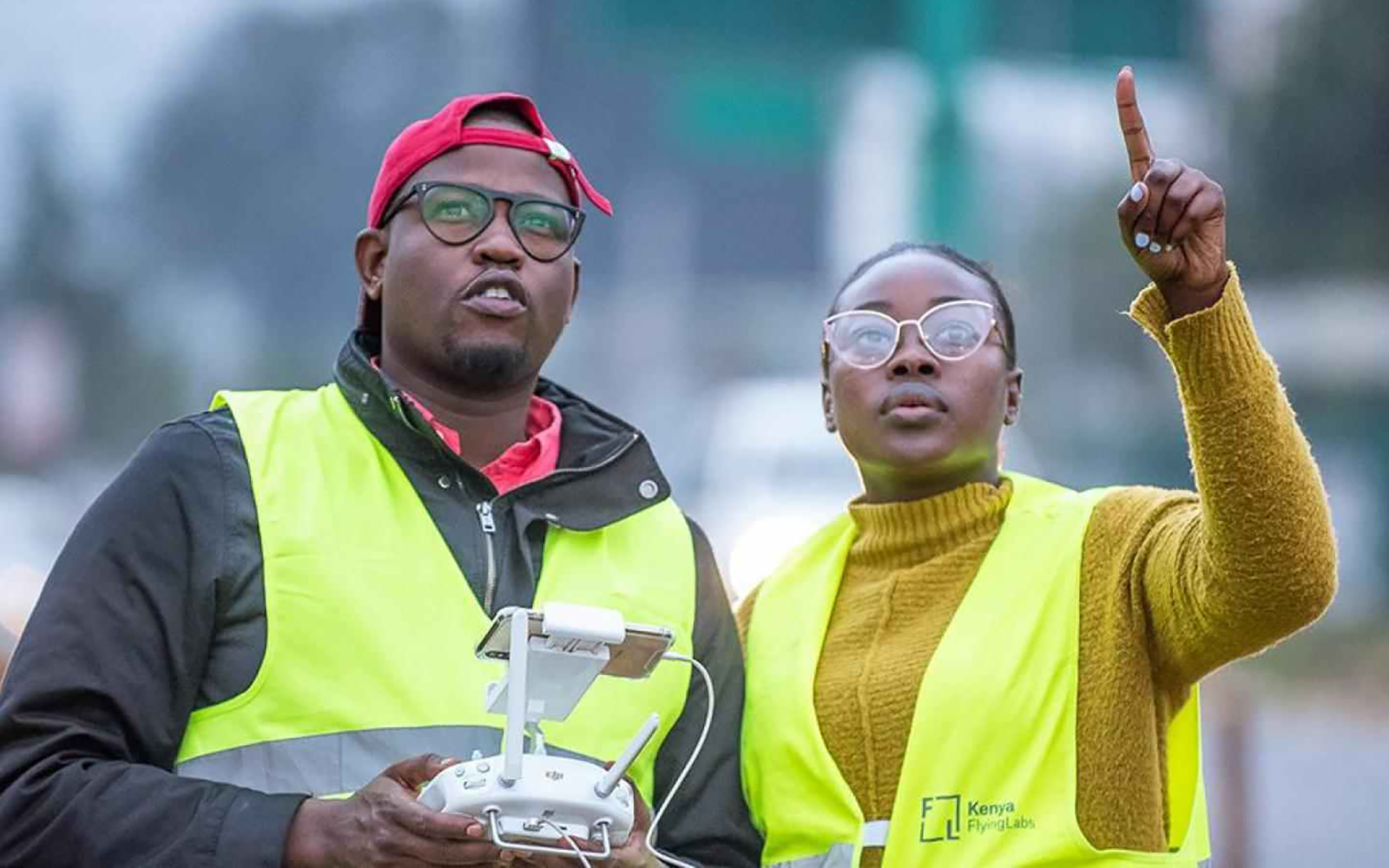
Championed by social impact organization WeRobotics, the Flying Labs Network is not just about implementing new technologies, but about fundamentally shifting power dynamics within the international aid and development sectors. At the heart of this endeavor is a recognition that solutions to the challenges that affect communities must be locally led, drawing from the experiences and insights of those who live and breathe those challenges every day. 

WeRobotics facilitates this work through a decentralized approach that activates local experts in the Global South with drone, data, and AI technologies. 

The social franchise model: Flying Labs  

A prime example is the Flying Labs Network, a social franchise that brings together local drone, data, and AI experts. These are existing organizations – sometimes for-profit, sometimes non-profit, and sometimes academic institutions – that join the network on their own initiative.  

This format is not about top-down solutions imposed from afar, it’s about fostering a collaborative ecosystem where local expertise drives innovation and creates sustainable change. As Sonja Betschart, Ashoka Fellow and co-founder of WeRobotics, puts it: "It's not about the tech. The value is in what you do with the tech and the impact it creates. And it’s in the who and the how. That's what we should concentrate on.  Who gets to decide, who leads, and how to do it.” 

This unique structure allows for a rapid scaling of impact without the need for a large, centralized organization.  

Sonja explains, "We don't open Flying Labs. They join the networks by themselves. It's existing local organizations who hold them, and we provide the framework and facilitate the network." 

Currently there are 40 Flying Labs across Africa, Latin America, the Caribbean, and Asia Pacific using drones and AI to tackle critical issues such as disaster management, agricultural innovation, and environmental protection. For example: 

  • Burkina Faso Flying Labs used drone data to map 800 hectares of irrigated plots, providing agricultural advisors with a decision-support tool that optimized input management, forecast crop yields, and identified under-producing plots.  
  • Senegal Flying Labs partnered with the Ministry of Environment and Sustainable Development and local park rangers to use drones for waterbird counts, which allowed them to collect more accurate data than traditional methods. 
  • Brazil Flying Labs collaborated with the Forest Foundation to map the Atlantic Forest to raise awareness among community members on the importance of forest preservation and the use of drone technology for this. The production of an orthomosaic map and other data led to the stakeholders reaffirming their commitment to awareness activities on forest preservation. 

The Power of Local 

Beyond strengthening local capacity through training and project services, Flying Labs also cultivate local decision-making and taking ownership of the processes, including working with regulators to shape drone and data policies. This approach is critical because emerging technologies require appropriate regulations to ensure their responsible and effective use. 

One key to the success of the Flying Labs Network is the emphasis on collaboration and knowledge sharing. Flying Labs document their work, sharing their experiences so that others can learn from their successes and challenges. This allows a project in Senegal to be replicated in Tanzania, for instance. It has also led to the development of strong regional collaborations within the Flying Labs Network, where regional strategies are being developed by the labs themselves, instead of being imposed by a global entity.  


Building bridges across sectors: Lenovo & WeRobotics 

Technology can be a powerful equalizer, but access to cutting-edge tools remains uneven. Local organizations in the Global South often lack the same resources as international entities, limiting their ability to maximize impact. To bridge this gap, Lenovo has supported Flying Labs with the technology needed to scale their work. 

This collaboration is part of a 3-year partnership between Lenovo and Ashoka to make technology a transformative force for positive change through social innovation, working closely with Ashoka Fellows from across the world. 

In this context, Lenovo has provided computers to support disaster management workshops in South Africa, while also creating opportunities for Lenovo employees to directly engage with the Flying Labs team.

“Each Flying Lab has a specific area of expertise, multiplying the overall project impact,” says Santiago Mendez, EMEA Head of Philanthropy at Lenovo. “For example, by using data models to predict wildfire expansion, they are not only preserving the planet but also protecting local communities from its impact. The same applies to using drones to collect data to improve agriculture— the impact is not only on the farmers that could improve their harvest, but also the communities that would have access to more and better food.” 

But beyond providing technology, Lenovo’s partnership reflects a broader shift in mindset—one that prioritizes collaboration over competition. Mendez emphasizes, “One of the biggest learnings of my Ashoka journey is that we need to move from competition to collaboration, and for the social sector, this is crucial as resources are limited.” 

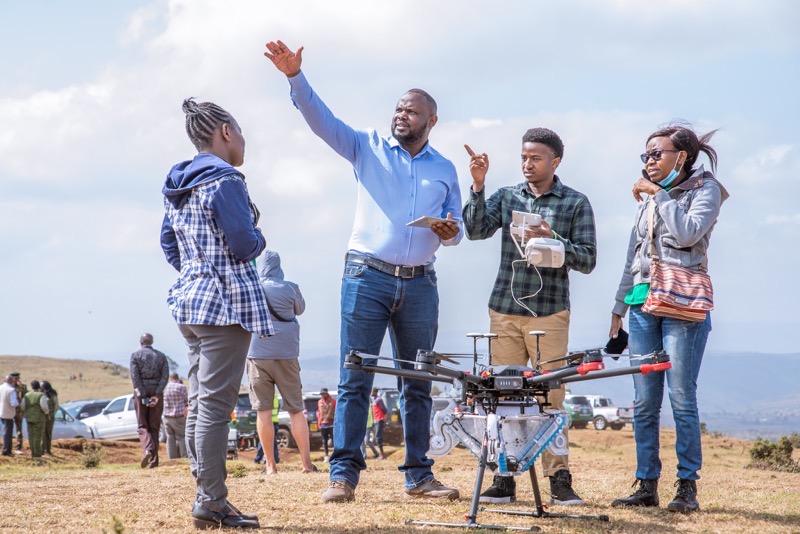
Seeder Drone Demo
Photo courtesy of WeRobotics

This philosophy is particularly evident in crisis response, “where most companies focus on relief efforts, allowing disaster response NGOs to act fast and provide the relief the victims need,” he explains. 

By fostering these cross-sector partnerships, WeRobotics are not just enabling technological advancements—they are helping to redefine how development work is done, ensuring that local expertise is at the forefront of solving global challenges. 

It’s about recognizing that expertise is not confined to the Global North, and that solutions are best developed by those who understand the local context.  

Sonja sums it up by saying, "It's not local versus global...it's together. It's just that the international sector has to understand that roles need to change. My aspiration is that one day the Global South countries start training the Global North communities on the use of drones and data to help solve complex social and environmental challenges.”  


*The insights, ideas and messages in this article have all been extracted and developed by humans. An AI assistant supported the writing.   


Ashoka and Lenovo are partnering to make technology a transformative force for positive change through social innovation, working closely with Ashoka Fellows from across the world. Learn more.